Showing posts with label Comedy. Show all posts

Tuesday, 5 August 2008

Le Fabuleux Destin d'Amélie Poulain


Better known as Amelie to UK viewers, this film charmed the world on it's initial release, and it's hard not to fall under the magical spell weaved, even if in po-faced cynical reflection, the film is about two social rejects stalking each other!

But such a critique is to do this film a disfavour. Amelie exudes charm and whimsy from every frame - it lightens the heart and makes one glad that films like this are still possible, in a world awash with cod-epics, torture-porn and other cynical marketing ploys.

Part of the charm comes in the whimsical setting: a sepia-toned Paris recalled from childhood memories, not from reality. It is utterly contrived, but, just like the best Coen Brothers films, you greet the contrivance with open arms and submerge yourself fully into it.

It's hard to think of a film that looks as lovely as this. Every frame is perfectly composed (albeit digitally enhanced) - this is the look and technique that Kurosawa and Kubrick dreamed of achieving, had they had the technology available to Jean-Pierre Jeunet (making a tremendous return to form after clashing with Hollywood on the dire Alien: Resurrection).

The entire cast are a delight - you could quite happily watch a film that centered on anyone of the other cast. A rare feat indeed.

But where this film succeeds most is where so many others would fail: it is kitsch, contrived and emotional, but never slips into being twee, sentimental or fake. That very, very thin line is thankfully never crossed.

Monday, 4 August 2008

Evil Dead II: Dead By Dawn


In 1980, some kids clubbed some money together and made The Evil Dead. It jumped on the horror band-wagon and told a basic story of some kids staying in a cabin in the woods, beset by demons. The acting, script and special effects were all rather rudimentary. What lifted the film were the humour and the direction: moments of slapstick and a total freedom of camera movement that were utterly inspired.

Some years later, they came back and made essentially the same film again, with a bigger budget. And this time the gallows-slapstick humour and wacky camera angles were pushed to the fore. They threw everything into the pot, nothing was left out. And it works. And it’s utterly joyous, exhilarating bravado film making by some kids that didn’t really know any better.

It’s like watching an 85 minute, gore-soaked Tex Avery cartoon. Every trick they could think of is in this film. The camera is restless – it is either strapped onto the front of a motorbike and chasing Bruce Campbell through the surprisingly large interior of the small wooden cabin, or it’s strapped to Campbell himself. Or in one breath-taking shot, the camera is attached to a crane, with Bruce Campbell on a spinning device hurtling him through every branch Sam Raimi can drive him through. And when the camera isn’t moving, there’s reverse-motion acting, stop-motion animation, speeded-up film. It’s absolutely breathless.

And at the centre of it, is a largely solo performance by cult-hero Bruce Campbell – he may not win acting awards, but this is one of the most enjoyable performances ever captured on camera. Behind the camera, Sam Raimi, never better, and you almost sense him twitching with new ideas for inflicting pain on Ash/Bruce. Film-making rarely ever comes this passionate, inventive, or exciting.

Wednesday, 30 July 2008

Carry On Up The Khyber


Those expecting Casablanca or Citizen Kane will be depressed by my choice for C, but I feel it is worthy of greater recognition. Of all the Carry On films, this is the only one that actually works on more than the basest of levels. Admittedly, it has all the double entendres, sexism and mugging to camera that you expect for a film series that had become utterly complacent with itself, and in 1968 was about to become utterly outdated by the arrival of Monty Python.

But Khyber works. The cast are all accustomed actors comfortable working with each other, but here they are given roles which push them a little bit further than many of the other entries in the series. The jokes are (largely) funny, and the dining room scene is a comedy classic. Of the cast, everyone is excellent, and Peter Butterworth deserves special mention, but Joan Sims is the standout, as the frustrated and dotty Lady Rough-Diamond.

There is some mild racism in it’s treatment of the Indian and Pakistani peoples, bit I think it acquits itself by applying exactly the same attitudes, and taking them further, to the British. Yes, in spite of all the crudities on display, Carry On Up The Khyber actually gives quite an in depth, self deprecating insight of British-ness, particularly in dealing with the then still fairly new concept of Britain as a small, cold and damp country in northern Europe, and no longer the centre of a world-spanning empire. Obviously, it’s not a lecture from an Oxford don, but a film with a story based around knobs, but nevertheless, it’s that extra dimension that raises it above the other Carry On films.

Friday, 25 July 2008

Bubba Ho-Tep


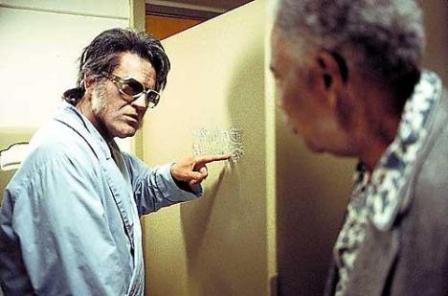
If there was ever a film that screamed “for the horror fanboys” in capital letters on a thousand and one internet forums, this is that film. Directed by Don Coscarelli (from the Phantasm films) and starring Bruce Campbell (from the Evil Dead films) with a pitch of Elvis vs. The Mummy, this promised to be a fun but inconsequential horror romp, with a fairly small but rabid target audience. That it managed to transcend these expectations and actually be a heart-warming and challenging piece about ageing and death was astounding.

Bruce Campbell plays a man who may (or may not) be Elvis, stuck in a flyblown nursing home with a cancerous penis. His two companions are the sympathetic-but-taking-no-shit nurse played by Ella Joyce, and civil rights activist Ossie Davis playing a man who may (or may not) be JFK. The jokes and monsters are all in place, and satisfyingly funny, but the film challenges it’s audience. How can we be content to abandon our parents and the elder generation in squalid, depressing homes such as these: yesterday’s heroes gave us civil rights, moon landings, rock and roll. And what do you do when you are staring death in the face? Is it possible to die with pride and honour intact?

Bruce Campbell is admittedly no Robert de Niro, but as Elvis he gives a tender performance of an old man who ran away from his heyday, and desperately wants it back. Ossie Davis and Ella Joyce are equally excellent in their supporting roles.

This film also changed my life, as I met the woman who would become my wife at the UK Premiere of this film. And if you’ve got to marry anybody, marry a lass who goes to Elvis vs. The Mummy films!

The Adventures of Baron Munchausen


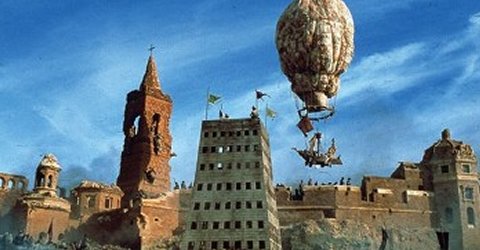
Baron Munchausen has baggage. It has a reputation as Gilliam’s Folly, a stinker that at the time it was the world’s biggest turkey. And it has to be said, it is an inconsistent, sketchy film with an ending that makes no sense. But Munchausen has a warmth and charm rarely seen in modern cinema, and even one of Gilliam’s failures is far more interesting than the majority of Hollywood cinema.

Munchausen picks up where Brazil left off – it is a story where the enemy is not the enemy at the gates, in the siege of a Mediterranean city, but the enemy is plodding, unimaginative by-the-book bureaucracy. Ironically enough, this has a modern resonance in our post 9/11 society: who is more destructive and dangerous - the mysterious foreign hordes, or our own fear-mongering government?

But the film is a creative, imaginative delight, with spectacular design, set pieces which you expect from a Gilliam film. What you don’t normally expect from Gilliam is the sheer quality of the acting – everyone is superb, with the exception of Robin Williams playing Robin Williams. John Neville is wonderful as the lead – despite being in his 60s when filming, his transformation in age depending entirely on his mood is entirely convincing, and Sarah Polley’s Sally is a child lead who is utterly delightful – only if half of her skill here had been split between the three leads of the Harry Potter films! The show is almost stolen by an unrecognisable Oliver Reed playing Mars, the God of War as a rough, blustery Yorkshireman doting on his trophy wife, Uma Thurman.

To finish it’s interesting to note that a shot Peter Jackson’s Lord of the Rings: The Two Towers is lifted directly from Munchausen. As Saruman addresses his Uruk-hai hordes from Isengard, the camera pulls back from his face, and keeps pulling back through the massed army till we realise the scale of it. Jackson accomplishes his shot with green screen and CGI. With Gilliam, it’s all real. And that’s what makes the difference.